1. Game Overview
In Thorganby, each player begins with a small developing settlement built around a humble starting camp. Over the course of the game, players expand their home settlement, place new terrain and buildings, grow their population, and develop increasingly valuable production chains.
A key tension in the game is deciding where to develop. Home Area buildings are fully controlled by the player who owns them and contribute to end-game scoring. Common Area buildings can be used cooperatively by multiple players, making larger and more advanced production possible, but their rewards are shared.
Core tension: build a productive home settlement while deciding when to rely on shared infrastructure in the common area.
2. Objective
The goal of Thorganby is to finish the game with the most victory points.
Main scoring sources
- Buildings in the home settlement
- Houses in the home settlement
- Valuable goods stored in village storage
- Storage-related bonuses
What the common area does
The common area does not score directly. It exists to create shared production opportunities that strengthen what players eventually build and store at home.
3. Components
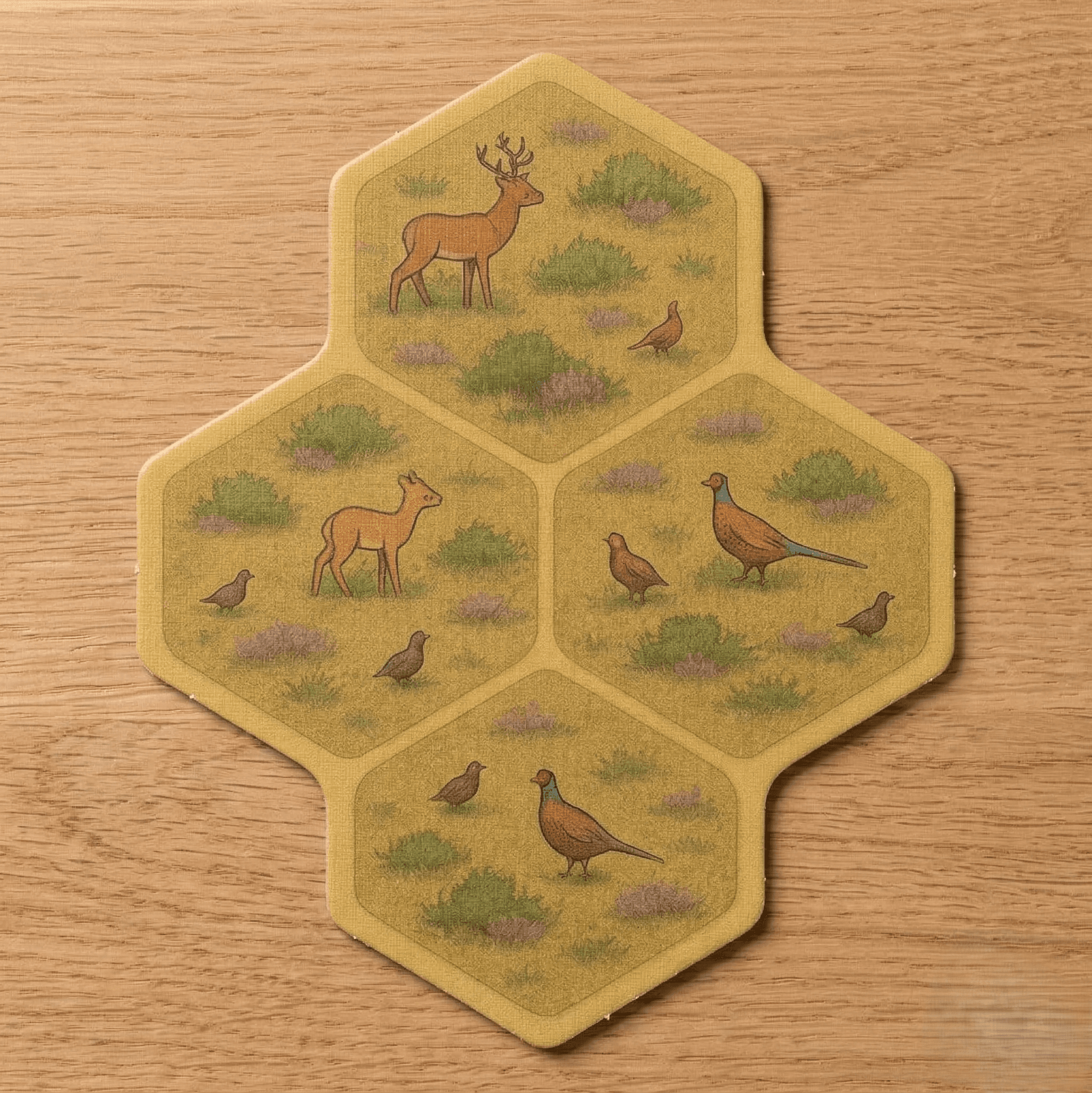
- Terrain tiles (4-hex grouped terrain tiles)
- Building tiles (1-hex building tiles)
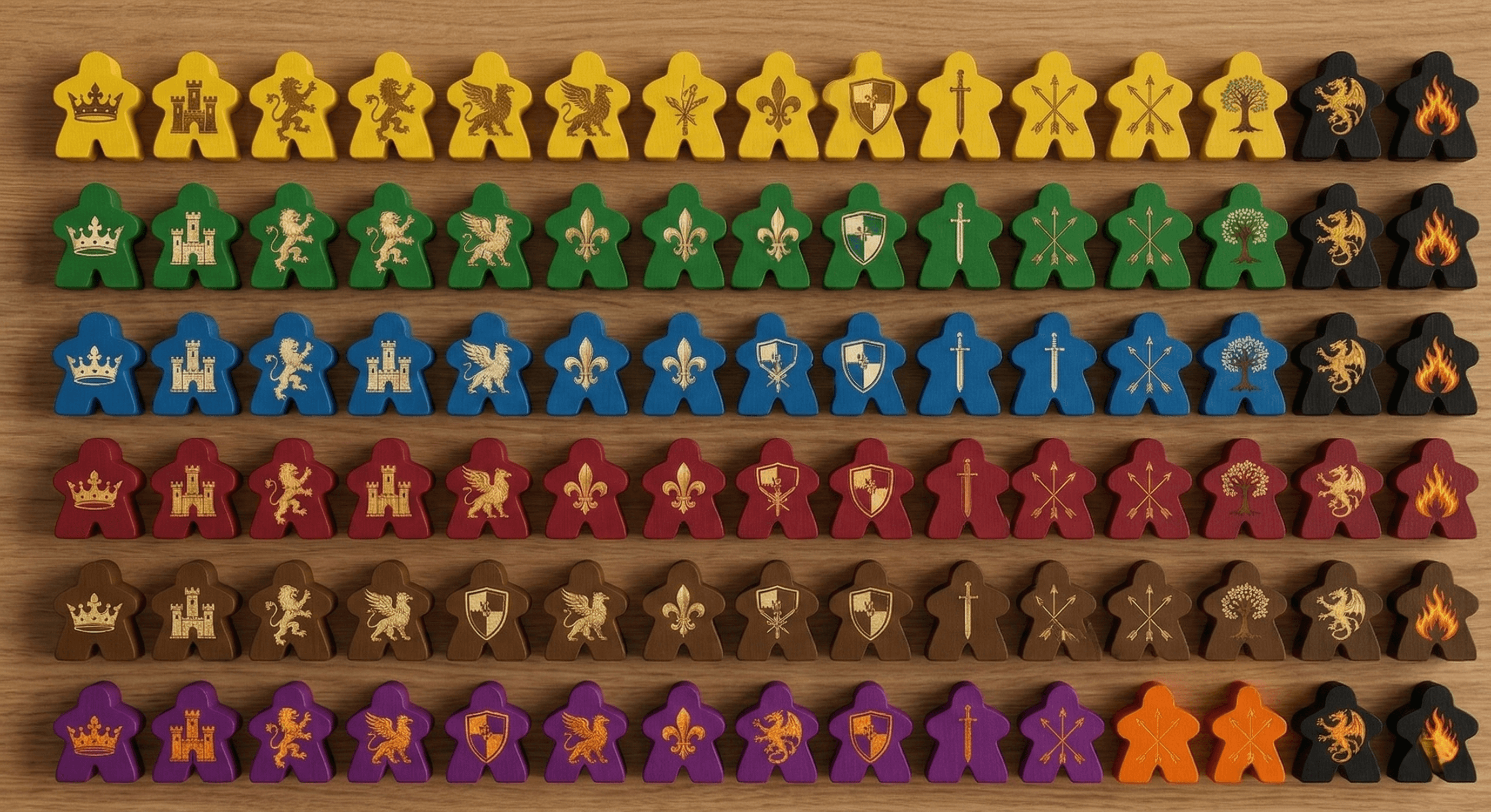
- Worker meeples / settlers
- Player boards
- Player screens
- Resource tokens
- Cart markers
- House markers
Objective cards are not used in this first playtest draft.
4. Setup
- Prepare the common supply.
- Prepare the tile supplies. Terrain tiles and building tiles are kept in separate piles and grouped into eras.
- Each player takes 1 player board, 15 settlers, and 1 player screen.
- Each player board contains a predefined starting terrain layout.
- Each player begins with a tent housing 2 settlers.
- Each player starts with 2 or 3 basic raw-resource buildings and places them onto valid terrain spaces in their home area.
- Each player gains the appropriate starting resources produced by those buildings.
- The common area begins empty in the centre of the table.
- Randomly determine the first player. Play proceeds clockwise.

5. Key Concepts
Settlers
Each worker meeple represents a settler living in your settlement. Settlers activate buildings, construct houses, and compete for access to production opportunities.
Tent and Housing
Each player starts with a tent housing 2 settlers. To grow beyond that, players must build houses in their home settlement.
Home Area
Only you may place settlers into your home buildings. If one activates, you receive all of its output, and those buildings matter for end-game scoring.
Common Area
The common area is shared by all players. Multiple players may contribute settlers to activate buildings there, and output is divided by contribution.
Production Chains
Terrain does nothing by itself. A relevant building must be placed on the correct terrain to produce goods.
- Forest + Logging Shed → Logs
- Field + Farm → Grain
- Mountain + Mine → Ore
- Logs → Sawmill → Planks
- Grain → Mill → Flour
- Ore → Smelter → Metal Ingots
6. Round Structure
| Phase | Summary |
|---|---|
| 1. Draw and Place a Tile | The active player chooses 1 terrain tile or 1 building tile, then places it in either their home area or the common area. |
| 2. Secret Worker Assignment | All players secretly decide where to send settlers. |
| 3. Reveal | All players reveal planned assignments simultaneously. |
| 4. Commit Allocations Clockwise | Starting with the active player, allocations are committed to buildings. |
| 5. Check Activation | Buildings activate only if they have exactly the required number of settlers. |
| 6. Resolve Production | Activated buildings produce in any order chosen by the active player. |
| 7. Transport and Home Actions | Players move common-area goods using carts and perform available home actions. |
| 8. Return Settlers | All settlers used that round return to their owner's available pool. |
| 9. Pass Active Player | The next player clockwise becomes the active player. |
7. Tile Placement Rules
Tile Types
- Terrain tiles: 4 connected hexes
- Building tiles: 1 hex
Terrain Placement
A terrain tile must be placed so that at least 2 hex sides touch an existing terrain tile in that same area. This applies in both the home area and the common area.
For now, there are no terrain-matching adjacency rules.
Home Area Terrain Limit
In a player's home area, they may only have one terrain tile of each terrain type. There is no such terrain-type limit in the common area.
Building Placement
A building tile is placed onto an empty terrain hex and must be placed on the correct terrain type for that building.
8. Worker Assignment, Reveal, and Production
Secret Assignments
Players record worker assignments on a planning sheet behind their screen. Each building in play should have a unique name so players can identify it clearly on their sheets.
An allocation is the number of settlers assigned to one specific named building.
Clockwise Commitment
Starting with the active player and proceeding clockwise, players place their allocations onto buildings. A player may choose the order in which they place their own allocations.
No Overfilling
A building may receive only the exact number of settlers needed to activate it. Extra settlers are not allowed.
If an Allocation Becomes Illegal
If a player planned to place settlers at a building but it becomes full before they commit that allocation, that allocation is lost for the round.
Production
All activated buildings produce once per round, during the active player's production step. Production happens only once; goods moved into another building later in the round are not processed until a future round.
9. Goods, Transport, and Home Economy
Home settlement goods
Goods in the home settlement do not need to be physically transported. Once produced in the home area, they go straight into village storage and are treated as globally available.
Common area goods
Goods produced in the common area remain physical and must be moved by player-specific carts. For this draft, a cart moves goods 1 hex per turn.
When a player successfully moves goods from the common area into their home settlement, those goods are added to village storage and no longer require transport tracking.
10. Houses and Population Growth
Building Houses
Players may build houses during the home actions step. To build a house, a player must spend the required resources and use 1 settler to perform the house-building action.
House Benefit
Each house provides room for 2 additional settlers. When a house is completed, the new settlers move in immediately but cannot be used until the next round.
Starting Tent
The starting tent houses the player's starting 2 settlers, is a starting condition only, and is not worth points.
11. End Game
The game ends when the final tile is placed. For this draft, that means the last remaining tile from all tile supplies combined, including both terrain and building tile supplies.
After the final tile is placed, each player receives one final full turn, and then the game is scored.
12. Scoring
| Category | Points |
|---|---|
| Home settlement buildings | 1 VP each |
| Houses | 2 VP each |
| Raw goods in village storage | 0 VP each |
| Intermediate goods in village storage | 1 VP each |
| Advanced goods in village storage | 2 VP each |
| Variety bonus | 3 VP if village storage contains at least 1 of each of 3 different goods |
| Full storage bonus | 3 VP if all currently available village storage spaces are filled |
Does not score
- Common area buildings
- The starting tent
- Settlers themselves
Tie-breaker
If tied, the tied player with the most advanced goods in village storage wins. If still tied, the tied player with the most houses wins. If still tied, the victory is shared.
13. Open Items / To Decide Later
Setup / Structure
- Exact number of eras
- Exact content of each era stack
- Final layouts of the unique player boards
- Exact starting building mix
- Exact starting resource amounts
Tile Placement
- Whether terrain adjacency rules should be added later
- Whether some advanced buildings can go on more than one terrain type
- Whether any buildings will ever be larger than 1 hex
- Whether terrain tiles should ever grant immediate placement bonuses
Worker System
- Whether lost allocations should always be lost
- Whether turn-order advantage needs balancing
- A cleaner hidden assignment method than paper sheets
- Exact worker thresholds for all buildings
Production / Transport / Scoring
- Exact output and recipes for each building
- Number of carts per player and carrying capacity
- Exact house recipe
- Whether advanced buildings should score more than basic buildings
14. Change Log
v0.1
- Created first consolidated playtest-ready rules draft
- Established home vs common area framework
- Established housing-driven population growth
- Established separate terrain/building draw system
- Established clockwise post-reveal allocation commitment
- Established common-area cart transport rules
- Added temporary playtest scoring values